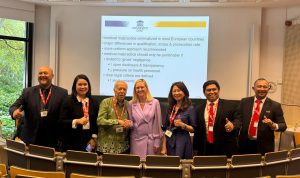
The Hague, Netherlands | CYBERNUSANTARA1.ID — The Winter Course on Public and Private International Law organized by the Hague Academy of International Law continued to demonstrate its global academic stature on Day Ten, Friday (23/1), with an in-depth lecture on Provisional Measures in International Law delivered by Catherine Amirfar, Deputy President of the American Society of International Law (ASIL). The course runs from 12–30 January 2026 at the historic Peace Palace, The Hague.
Catherine Amirfar, a widely respected practitioner and scholar in international dispute settlement, explored the evolving role of provisional measures in both interstate and investor–state disputes.
Her presentation emphasized how provisional measures function not merely as procedural tools, but as vital safeguards to preserve rights, prevent irreparable harm, and maintain the integrity of international adjudication.

She highlighted recent jurisprudence from international courts and tribunals, underlining how provisional measures increasingly reflect the binding authority and moral force of international law in times of geopolitical uncertainty.
Indonesian Perspective: Strengthening Legal Integrity
Responding to the lecture, Prof. Sabela Gayo, S.H., M.H., Ph.D., CPL., CPCLE., ACIArb., CPM., CPArb., CPLI., President of the Indonesia Dispute Board (IDB), underscored the strategic importance of the topic for developing and emerging legal systems, including Indonesia.
“Provisional measures are no longer a peripheral concept in international law. They are a manifestation of judicial responsibility to ensure justice is not rendered meaningless by delay,” Prof. Sabela stated.
He emphasized that Amirfar’s lecture offered both theoretical clarity and practical guidance for arbitrators, judges, and counsel engaged in cross-border disputes.
“What we learned today is highly relevant for Indonesia and ASEAN jurisdictions. Provisional measures teach us how international law responds swiftly and ethically to protect legal rights, even before a final decision is rendered,” he added.
Prof. Sabela also noted that participation in the Hague Academy Winter Course reflects Indonesia’s growing commitment to global legal standards.
“The Hague Academy is not only an academic institution; it is a moral compass for international law. Indonesian legal professionals must continue to engage with this ecosystem to strengthen our national dispute resolution framework with international credibility and integrity,” he said.
Bridging Global Theory and National Practice
According to Prof. Sabela, the lecture reaffirmed the necessity of aligning domestic dispute resolution mechanisms with international norms, particularly in arbitration and international litigation.
“Integrity in law is built when national practice resonates with international principles. Provisional measures are a clear example of how urgency, fairness, and legal certainty must coexist,” he concluded.
The Winter Course continues to attract judges, diplomats, academics, and practitioners from around the world, fostering dialogue that bridges public and private international law. As the program enters its final week, discussions are expected to further address contemporary challenges shaping the future of international legal order.